

The Connected Retail DC: From Dock to Store, Compliance to Claims
By Joe Leucht | Director of Commercial Strategy, Hardesty Technologies
Retail Distribution Has Changed
Retail distribution centers are under pressure from every direction.
Consumers expect products to be available when promised, orders to ship quickly, inventory information to be accurate, and returns to be simple. Stores expect replenishment to arrive complete and on time. Operations teams are expected to increase throughput while controlling labor costs. Finance wants better inventory accuracy. Compliance teams want proof. And when something goes wrong, everyone wants to know exactly where the break down occurred.
That pressure has fundamentally changed the role of the retail distribution center.
A DC is no longer simply a place where merchandise is received, stored, picked, packed, and shipped to stores. It is the operational control point connecting suppliers, inventory, stores, ecommerce, transportation, returns, and ultimately the customer.
The challenge is no longer just moving product.
It is moving product faster while improving accuracy, proving compliance, reducing claims, and maintaining visibility throughout the journey.
That is where connected warehouse technology becomes increasingly important.
The Journey From Dock to Store Is a Chain of Decisions
Every shipment moving through a retail DC creates a series of operational events.
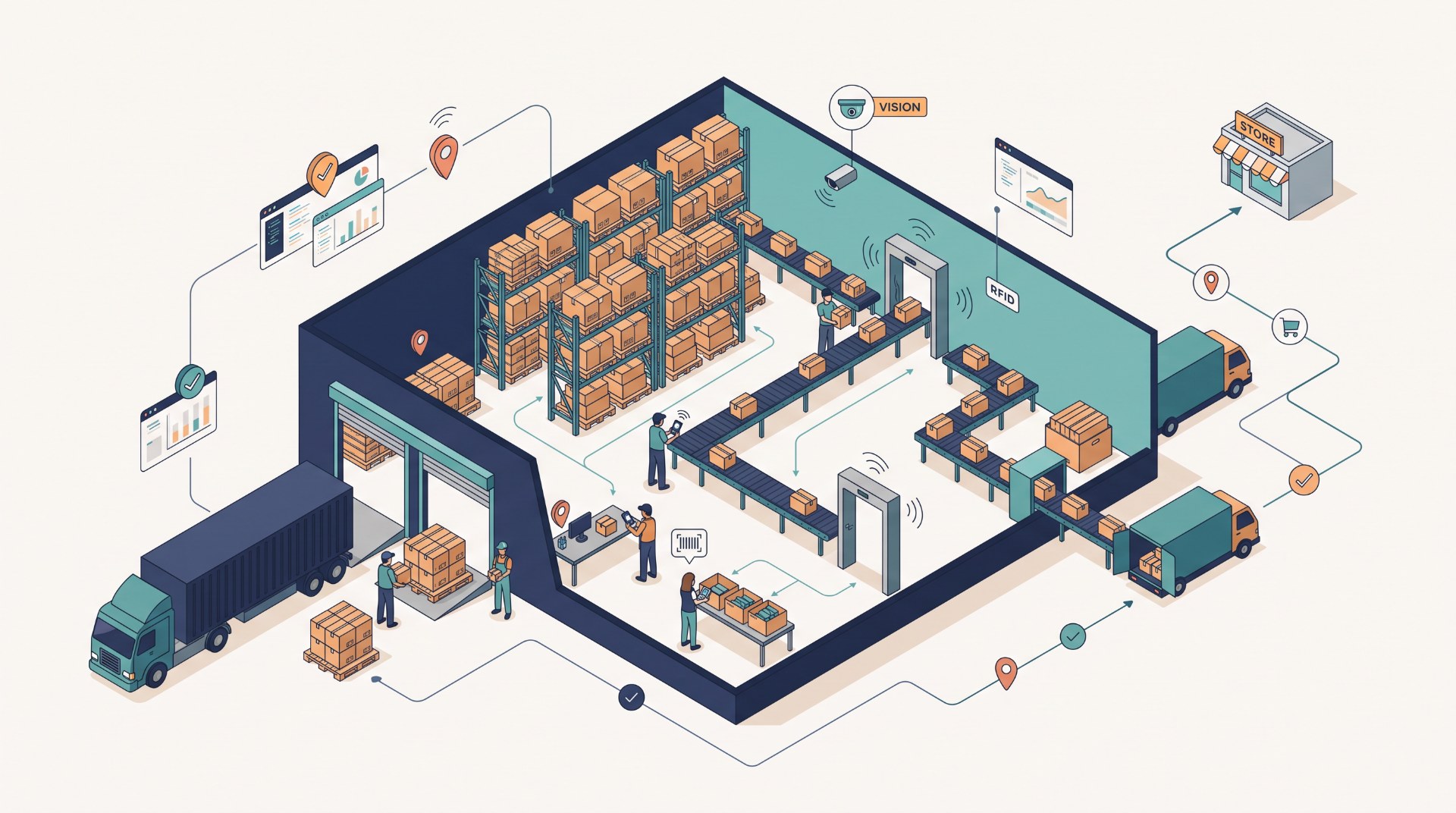
Product arrives at the dock. It is received and identified. Inventory is put away. Orders are released. Items are picked. Cases and pallets are built. Labels are applied. Shipments are staged. Loads are verified. Trucks depart. Stores receive the merchandise.
Every one of those steps represents an opportunity for an error — or an opportunity to capture information that can prevent one.
A missing scan, incorrect label, wrong quantity, damaged product, misplaced pallet, or shipping error may not become visible until the product reaches the store. By then, the cost of the mistake is much higher.
That is why modern retail DCs are moving toward more connected processes where technology can provide visibility and verification throughout the workflow.
The objective is not to add more scans or more systems simply because the technology exists.
The objective is to create confidence that the right product is in the right place, moving through the right process, with the right information attached to it.
Compliance Is Becoming a DC-Level Responsibility
Retail compliance increasingly starts long before merchandise reaches the store.
Labels need to be correct. Barcodes need to scan. Cartons need to contain the expected products. Pallets need to meet retailer requirements. Shipping documentation needs to match the physical shipment. Store-specific requirements need to be followed.
When those controls fail, the result can be more than an operational inconvenience. It can become a chargeback, shortage claim, rejected shipment, delayed replenishment, customer complaint, or costly investigation.
The most important question after a dispute is often simple:
Can you prove what happened?
A modern retail DC should be able to create a digital record of key events — what was received, what was picked, what was verified, what was loaded, and what was shipped.
Barcode scanning, RFID, computer vision, mobile workflows and connected systems can help create that record.
More importantly, they can help identify problems before the shipment leaves the building.
That changes claims management from a reactive process into a preventive one.
Claims Prevention Starts Before the Trailer Leaves
Claims are often investigated after the fact.
A store reports a shortage. A carton arrives with the wrong product. A pallet does not match the expected contents. A retailer issues a chargeback. Someone then has to reconstruct what happened.
Who picked it?
Was the correct quantity picked?
Was the carton associated with the correct order?
Was the pallet verified?
Was the shipment complete when it left the DC?
Traditional processes may not provide enough evidence to answer those questions quickly. Connected AIDC technologies can.
Barcode verification can confirm identity and transactions. RFID can provide item - or case - level visibility. Computer vision can inspect cartons, labels and pallets. Mobile workflows can guide employees through required steps. AI can help identify anomalies and exceptions.
Together, these technologies can create a digital chain of custody for inventory. That means the DC can do more than investigate a claim.
It can build controls designed to prevent the claim from happening in the first place.
RFID: Moving From Inventory Counts to Inventory Intelligence
RFID is often associated with faster inventory counts, but its potential inside a retail DC is much broader.
RFID can help answer questions such as:
Where is the inventory?
What arrived?
What has been picked?
What has been staged?
What was loaded?
What was shipped?
What is available for ecommerce?
What came back through returns?
Where are discrepancies occurring?
Unlike traditional barcode workflows, RFID can identify multiple tagged items without requiring the same line - of - sight process. That makes it particularly useful for receiving, cycle counts, staging, shipping, audits and inventory verification.
The larger opportunity is not simply replacing a manual scan. It is improving inventory confidence.
For retailers supporting both store replenishment and ecommerce, that distinction becomes even more important. Inventory availability is only useful if the physical inventory can actually be located and fulfilled.
BLE and IoT: Visibility Beyond the Inventory
Not everything important inside a retail DC is merchandise.
Pallets, carts, totes, containers, rolling equipment, returnable assets and other material-handling resources are constantly moving through the facility.
Yet many of those assets have little or no real-time visibility.
Bluetooth Low Energy and other IoT technologies can help close that gap. Instead of relying entirely on employees to manually scan an asset every time it moves, connected technologies can provide location and movement information automatically.
That can help answer a deceptively simple question:
Where is it right now?
Better asset visibility can reduce time spent searching for equipment, improve utilization, identify bottlenecks and help teams understand how materials move through the facility.
The value becomes even greater when IoT data is combined with WMS transactions, mobile devices, RFID and other operational systems.
The goal is not simply to track an asset. It is to understand what is happening around it.
AI and Computer Vision: A Second Set of Eyes
Artificial intelligence is creating new opportunities to add verification and intelligence to warehouse workflows. Computer vision can inspect products, cartons, pallets and labels. AI can help identify anomalies, recognize patterns and determine where human attention may be required.
Consider a shipping process where a pallet is built for a store.
Instead of relying entirely on an employee to recognize every possible problem, vision technology can provide another layer of verification before the pallet leaves the facility. The same concept can apply to cycle counts, audits, picking, packing and returns.
The goal is not necessarily to replace the employee. It is to give the employee another set of eyes.
That creates an important shift in warehouse operations. Instead of inspecting everything manually, technology can help identify where inspection or intervention is most valuable.
For retailers under pressure to increase throughput without sacrificing accuracy, that can be a significant advantage.
The Connected DC Needs a Reliable Foundation
All of these technologies depend on something that is easy to overlook: connectivity.
RFID readers, BLE gateways, mobile computers, AI cameras, printers, scanners, IoT sensors, vehicle-mounted computers, voice devices, WMS applications and cloud systems all need areliable network to communicate. In a modern distribution center, wireless connectivity is not simply an IT convenience. It is part of the operational infrastructure.
A 30-second interruption on an office laptop may be an annoyance. A connectivity problem during receiving, picking, loading or ecommerce fulfillment can become an operational event.
A mobile worker who loses connectivity may lose access to the workflow. A printer that cannot communicate may stop a shipping process. A camera that cannot transmit may lose a verification opportunity. An RFID reader that cannot communicate cannot provide the visibility the operation depends upon.
As retailers add more connected devices, network requirements become more complex. Coverage matters. Capacity matters. Roaming matters. Interference matters. Device density matters. Facility layout matters.
That is why network design and assessment should be considered along side the technologies the network supports.
The smarter the warehouse becomes, the more important its connectivity foundation becomes.
Ecommerce Is Raising the Speed Requirement
Retail DCs were traditionally optimized around store replenishment. Ecommerce changed the equation.
The same facility may now ship full pallets to stores, cases to regional facilities, individual items to consumers, orders for pickup, transfers between locations and returns back into inventory.
The expectation for speed has changed with it.
Consumers have become accustomed to fast fulfillment, accurate inventory availability, reliable tracking and simple returns. Retailers do not necessarily need to become Amazon, but they increasingly need to deliver an Amazon-like experience.
That puts enormous pressure on the DC.
If an ecommerce system says an item is available but the DC cannot locate it, the problem is no longer just an inventory problem. It is a customer experience problem. If the wrong item is shipped, it becomes a returns problem. If an order ships late, it becomes a customer retention problem.
The physical movement of inventory and the digital customer experience are now inseparable.
Reverse Logistics Is Part of the Same Journey
Returns are no longer an exception to the retail supply chain. They are part of it.
Returned merchandise may arrive from consumers, stores or other facilities. It may need to be identified, inspected, graded, repackaged, restocked, redirected, refurbished or disposed of.
Every additional touch creates cost. Every additional touch also creates another opportunity for error.
Barcode and RFID technologies can establish product identity. Mobile workflows can guide inspection and disposition. Computer vision can help identify condition or anomalies. Connected systems can provide visibility into where returned inventory is within the process.
The faster a retailer can determine what happened to returned merchandise, the faster it can make a decision about what happens next. That matters because returned merchandise is still inventory.
Reverse logistics deserves the same visibility and process discipline as outbound fulfillment.
The Goal Is Not One Technology
Retailers do not need to choose between RFID, AI, BLE, mobile computing, automation, networking or their WMS.
The opportunity is to connect them.
Imagine a pallet moving througha retail DC. A barcode identifies the shipment. RFID provides inventory visibility. A mobile computer guides the operator. BLE provides location awareness for an asset. Computer vision verifies the pallet or carton. AI identifies an exception. The WMS provides business context. The network connects the entire process.
The result is more than a collection of technologies. It is an operational ecosystem where physical events can generate digital information that can be acted upon.
That is the shift from isolated transactions to connected intelligence.
How to Get Started: A Practical Technology Roadmap for the Retail DC
Modernizing a retail distribution center does not mean implementing every new technology at once.
Start by identifying where the operation is losing time, accuracy, visibility or money. Then match the technology to the problem. The right starting point will be different for every DC. For some, it may be inventory accuracy. For others, it may be aging devices, unreliable connectivity, shipping errors or a returns process that is too manual.
A practical assessment mightlook like this:
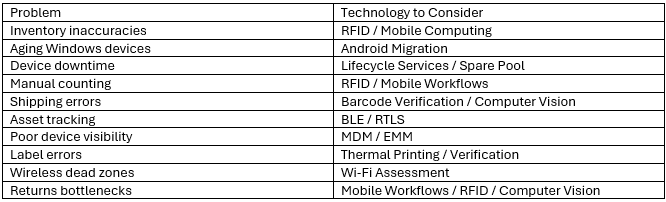
The goal is not to implement technology because it is new. The goal is to solve the operational problem that is costing the DC time, accuracy, visibility or money.
Start With the Problem. Then Build the Technology Roadmap.
A retailer may not need RFID everywhere. Another may have an immediate need for better wireless coverage. One DC may need to modernize aging Windows devices before it can deploy new workflows. Another may have a claims problem that can be addressed through barcode verification and computer vision.
The right roadmap depends on the operation.
The most effective technology strategy starts with the workflow, identifies the friction, measures the business impact, and then determines where technology can make a meaningful difference.
That approach also makes modernization more manageable. Instead of treating the DC as one enormous technology project, retailers can prioritize the areas where an improvement will have the greatest operational and financial impact.
From Technology Projects to a Connected DC Strategy
Retail distribution centers do not need more technology for technology's sake. They need technology that makes the operation more accurate, more visible, more resilient, and faster.
RFID can improve inventory visibility. BLE can locate assets. AI and computer vision can provide another layer of verification. Mobile computing can put the right workflow in the hands of the operator. MDM can keep devices available and manageable. Lifecycle services can reduce the operational impact of device failures. And a reliable wireless network can connect all of it.
The opportunity is not any one of these technologies individually. It's what happens when they work together.
A connected retail DC can move beyond simply knowing that a transaction occurred. It can begin to understand what is happening across the operation in real time where inventory is, where assets are, where exceptions are occurring, and where action is required.
That visibility can reduce claims, improve compliance, accelerate fulfillment, increase inventory confidence, simplify audits, and help retailers deliver the speed and accuracy consumers now expect. From dock to store. From store to consumer. And increasingly, from consumer back through reverse logistics.
The future of retail distribution isn't simply about moving more product. It's about creating a connected, intelligent and defensible journey for every product that moves through the DC.
Building a More Connected Retail DC
At Hardesty Technologies, we help retailers evaluate the technology connecting the physical movement of inventory to the digital systems managing it — from barcode and RFID to mobile computing, thermal printing, IoT, BLE, AI-powered vision, wireless connectivity, device management and lifecycle services.
The objective isn't to add another piece of technology to the warehouse. It's to build a more accurate, visible, compliant and connected operation from dock to store.
If your retail distribution center is struggling with inventory accuracy, claims, compliance, manual audits, fulfillment speed, aging devices, unreliable connectivity or limited visibility, the first step may not be replacing your entire infrastructure. It may be identifying where the next layer of visibility can eliminate the most friction.
Start with the problem. Build the roadmap. Connect the operation.
Email our team today to get started: Sales@hardestytech.com
About the Author
Joe Leucht is Director of Commercial Strategy at Hardesty Technologies and an 18-year veteran of warehouse and supply chain technology. His experience spans barcode, RFID, mobile computing, wireless connectivity, warehouse technology, managed services and lifecycle strategy. At Hardesty Technologies, Joe works with organizations to connect technology investments to real-world operational challenges — helping distribution and logistics teams improve visibility, productivity, accuracy and the reliability of the systems their operations depend on.
His perspective is grounded in the belief that technology should solve operational problems, not simply add another layer of complexity.