

From Data Capture to Operational Perception: The Next Evolution of the Warehouse
By Joe Leucht | Director of Commercial Strategy, Hardesty Technologies
How the evolution from barcodes to AI-powered perception is changing what warehouse automation can actually mean
For decades, the warehouse has been built around a simple premise: if you want accurate information, someone needs to capture it.
A pallet arrives. Scan it.
A pallet moves. Scan it.
A case gets picked. Scan it.
A shipment is loaded. Verify it.
Something gets damaged. Report it.
Someone enters a restricted area. Hopefully, someone notices.
A forklift has a near miss. Hopefully, someone notices.
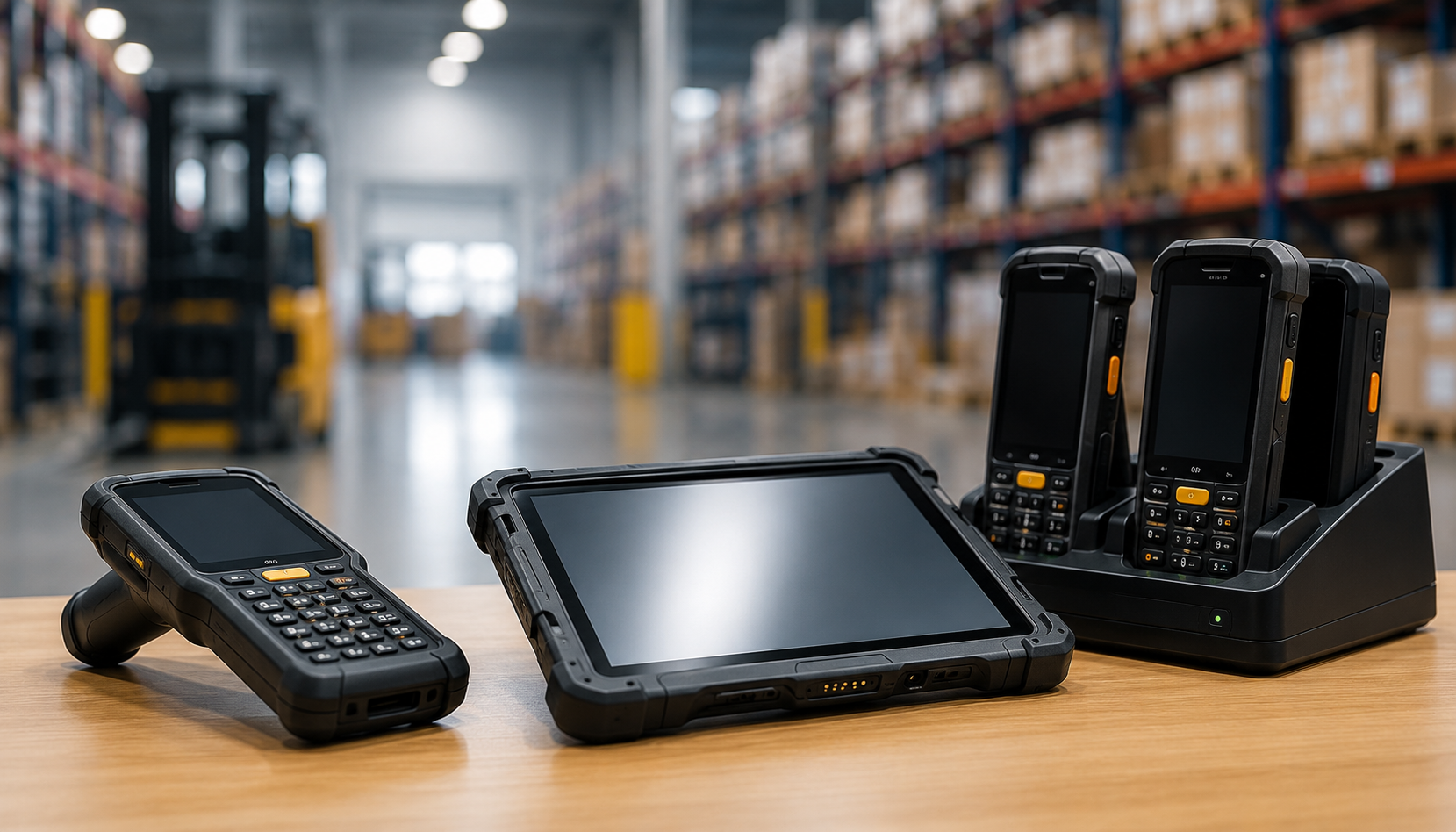
That model has served the industry well. Barcodes, scanners, mobile computers, printers and warehouse software transformed distribution by connecting physical activity to digital systems.
But there is a fundamental limitation: The warehouse is doing far more than its systems can actually see.
That is beginning to change.
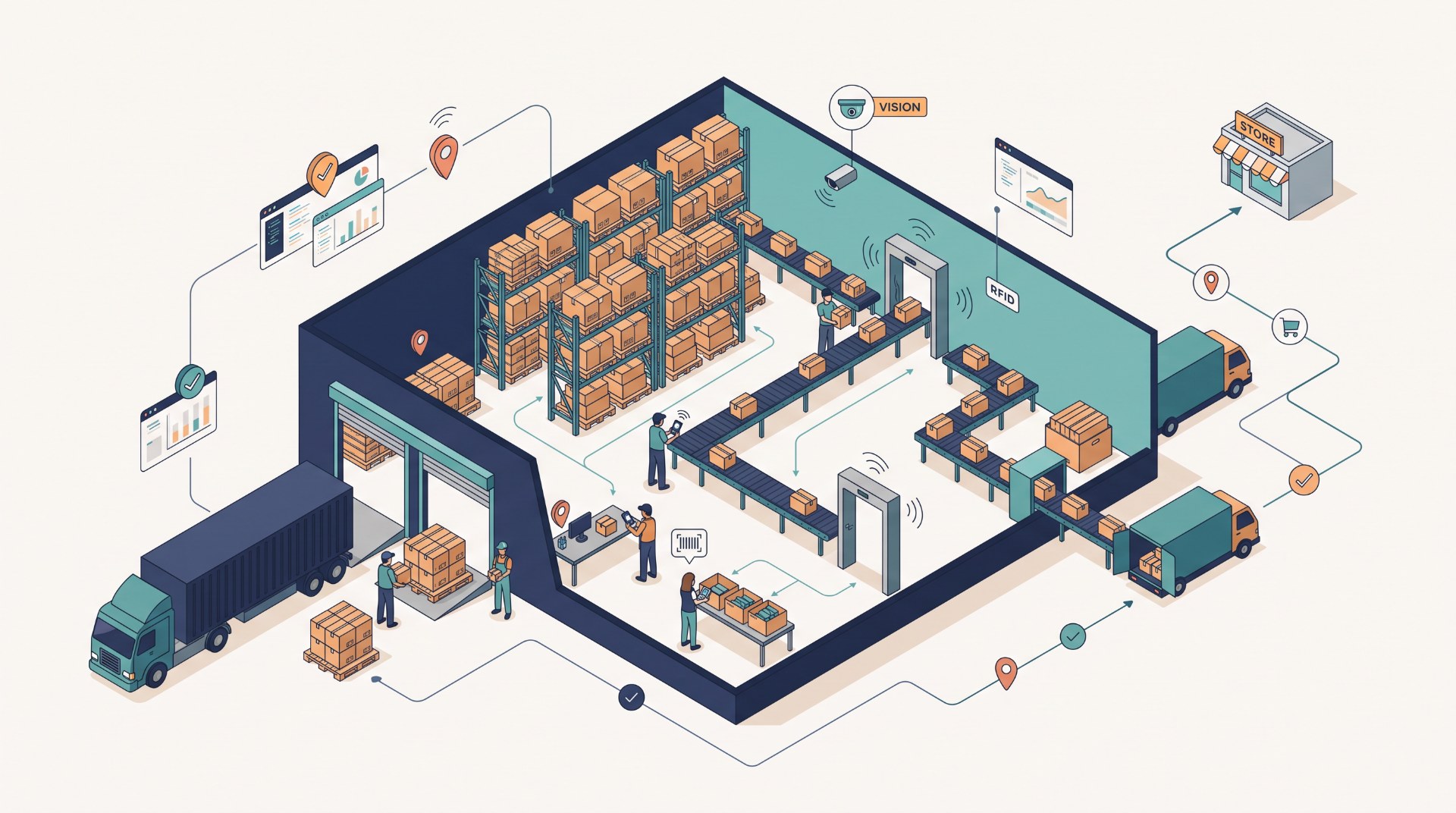
Artificial intelligence and computer vision are creating a new layer of warehouse intelligence—one that doesn't simply capture transactions, but can observe activity, recognize patterns, understand context and turn what is happening in the physical environment into actionable information.
At Hardesty Technologies, this evolution is central to where we are going. Our journey from Bar Code Depot to Hardesty Technologies wasn't simply a change in name. It reflects a change in how we think about the warehouse technology market and our role within it.
We came from the world of data capture.
We're helping build the world of operational perception.
From Capturing Data to Understanding the Operation
The technologies that built the modern warehouse aren't disappearing.
Barcodes still matter. Scanners still matter. Mobile computers still matter. Printers, labels, networks, WMS platforms and wireless infrastructure remain critical pieces of the operation.
But the technology conversation is expanding.
For years, the primary question was: How do we capture the transaction?
Now the question is becoming: How do we understand what is actually happening?
That distinction is enormous. A barcode tells a system what was scanned. Computer vision can potentially tell a system what it sees. A handheld scanner requires an operator to initiate an action. An intelligent vision system can continuously observe activity without requiring someone to stop what they're doing.
That doesn't mean humans become less important. It means we can stop asking people to perform data-capture tasks that technology may increasingly be capable of performing itself.
This is the shift from data capture to perception.
And we believe it will become one of the defining technology transitions in warehousing over the next decade.
The Warehouse Doesn't Necessarily Need More Automation. It Needs More Awareness.
When executives hear "warehouse automation," the conversation often immediately moves toward robots, autonomous mobile robots, automated storage and retrieval systems, conveyors or autonomous forklifts.
Those technologies have enormous potential.
But automation isn't always the first problem to solve.
Before you automate a process, you need to understand it. Before you optimize a process, you need visibility into it. Before you trust an autonomous system, you need reliable perception.
That's why we believe there is an important step between today's warehouse and tomorrow's fully automated warehouse: Make the warehouse more observable.
Imagine a warehouse where inventory movement doesn't depend entirely on manual scanning. Imagine pick validation happening as the work occurs rather than through a downstream audit. Imagine continuously knowing where pallets are located without requiring an employee to stop and perform another transaction. Imagine having visual evidence of how an order was picked, staged and loaded. Imagine a safety system that doesn't simply record video but recognizes potentially dangerous behavior. Imagine being able to investigate a customer claim using actual visual evidence rather than reconstructing what happened from memory, scans and paperwork.
That's not science fiction. The technologies are emerging now.
Why We Partner With Technology Innovators
At Hardesty, we don't believe one technology company can solve every warehouse problem.
Warehouses are too complex. The workflows are too varied.
And the technology landscape is changing too quickly.
That's why strategic partnerships are such an important part of our approach.
We look for innovators developing technologies that solve meaningful problems, then we focus on something equally important: How does that technology actually work inside a real warehouse?
A successful deployment isn't simply about purchasing hardware or software. It involves understanding the customer's workflow, existing infrastructure, WMS environment, network, material-handling equipment, operators and operational objectives. It involves installation. Configuration. Integration. Training. Support. Troubleshooting. Lifecycle management. And, ultimately, proving that the technology creates business value.
That's where our experience matters.
We understand the traditional AIDC environment because we've been part of it for years. We understand the realities of warehouse operations because technology doesn't get deployed into PowerPoint presentations—it gets deployed into facilities where people are moving product around the clock. Our evolution into Hardesty Technologies is about bringing that experience forward.
We're not abandoning the technologies that made us successful.
We're building on them.
Putting Intelligence on the Forklift
One of the most interesting examples of this evolution is Retina Robotics' Warehouse Automation Module, or WAM™.
WAM challenges a basic assumption that has existed in warehousing for decades: If you want accurate inventory information, someone needs to scan the inventory.
What happens if they don't?
What happens when labels are damaged?
What happens when a pallet is moved without being scanned?
What happens when an operator is focused on throughput and the scan becomes an afterthought?
What happens when inventory is stored in a way that makes traditional scanning difficult?
The answer has traditionally been more processes, more audits and more labor.
WAM takes a different approach.
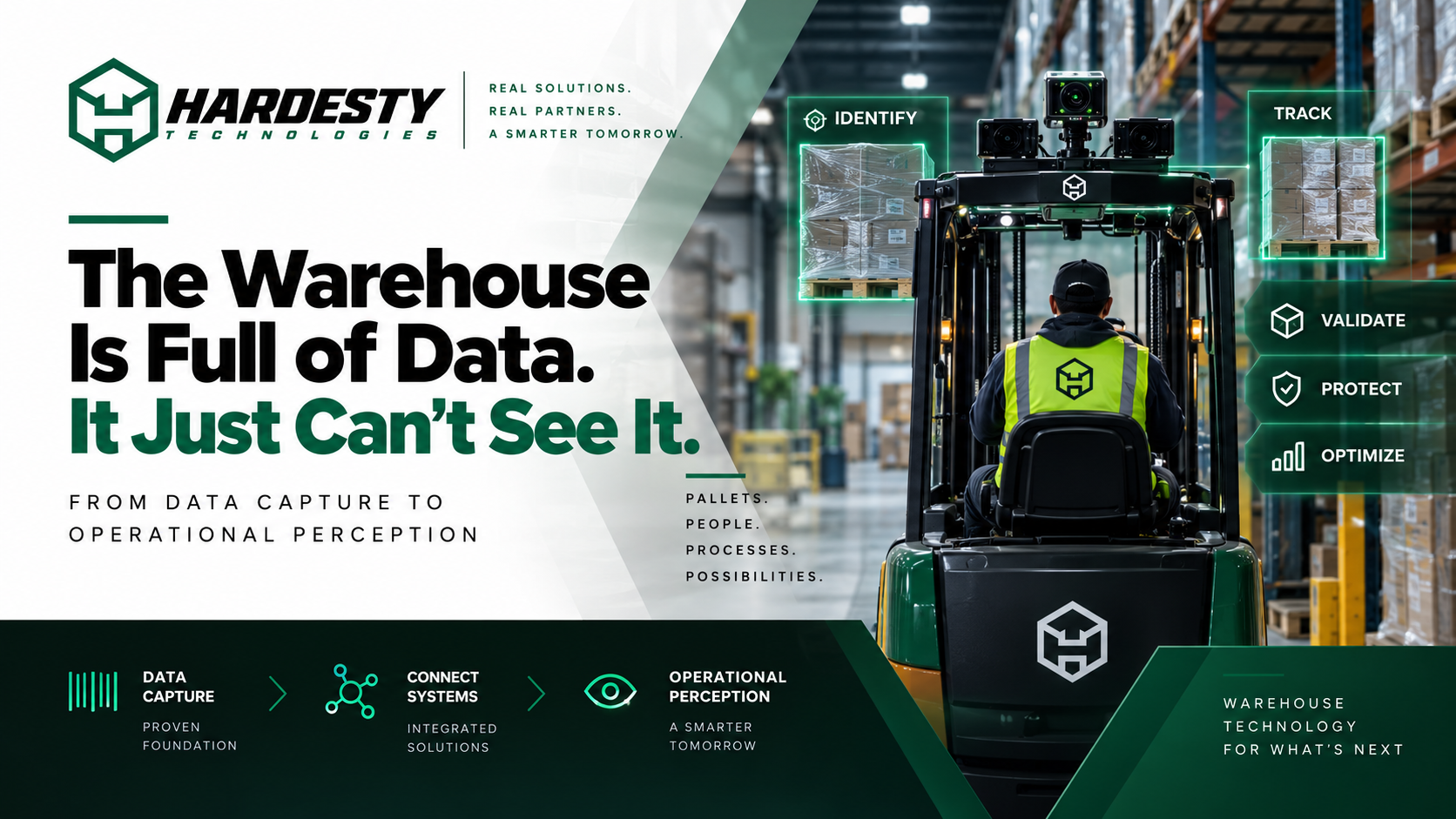
Instead of relying exclusively on labels and manual scanning, WAM uses edge computer vision and AI mounted directly to existing forklifts and material-handling vehicles. The forklift becomes more than a vehicle moving inventory.
It becomes a mobile perception platform.
As the vehicle performs its normal work, WAM can observe inventory movement, identify and track inventory, validate picks and continuously build a picture of where inventory is located. That opens the door to a very different model of warehouse execution. The operator doesn't necessarily need to stop and tell the system what happened every time.
The system can increasingly understand what happened by observing the work.
That is a profound change.
The Business Case Isn't Just Labor Savings
It's tempting to look at AI and immediately ask: "How many employees can this replace?"
We think that's the wrong first question.
The better question is: "How much operational friction can this eliminate?"
Consider the cost of an inventory error. A misplaced pallet can trigger a search. The search consumes labor. The order may be delayed. Customer service gets involved. A shipment may require an expedite. The customer may receive the wrong product. A chargeback may follow. Management may spend time investigating the incident. The inventory record may need to be corrected. None of those individual costs necessarily appears as a giant line item called "inventory inaccuracy." They're distributed throughout the operation.
The same is true for manual auditing.
The same is true for quality problems.
The same is true for customer claims.
The same is true for safety incidents.
AI-powered perception creates an opportunity to attack those costs at their source by making more of the physical operation visible in real time. That is a much bigger business case than simply reducing scanning labor.
From Inventory Accuracy to Chargeback Defense
There is another economic opportunity that deserves more attention: proof.
Warehouse and distribution leaders increasingly deal with disputes involving customers, carriers, suppliers and internal operations.
Was the pallet loaded correctly?
Was the shipment complete?
Was the product damaged before it left the facility?
Was the wrong case picked?
Was an order staged incorrectly?
Who handled the product?
When did the problem occur?
Without reliable evidence, organizations are often left reconstructing events after the fact. AI vision changes the conversation.
Instead of relying entirely on manual documentation, organizations can begin building a visual record of operational events. That can support quality control, claims investigation, order verification and chain-of-custody processes. The value isn't necessarily just preventing the mistake. It's being able to establish what actually happened.
For organizations dealing with large shipment volumes and customer chargebacks, that visibility can have real financial value.
Arvist: Seeing More Than Inventory
Inventory isn't the only thing a warehouse needs to understand.
People move through the facility. Forklifts interact with pedestrians. Loads are staged. Orders are picked. Products are damaged. Safety procedures are followed—or not followed. Equipment moves through defined areas. Processes happen according to standards—or they don't.
This is where AI-powered visual intelligence platforms such as Arvist become an important part of the larger picture. Rather than thinking about cameras as passive recording devices, AI can turn visual infrastructure into a source of operational intelligence. That can include areas such as safety, compliance, quality control, damage detection, order verification, security and claims.
The distinction matters.
A traditional camera might record an event. An AI-powered vision system can potentially identify, interpret and act on the event.
That moves video from being primarily a historical record to becoming part of the operational workflow.
And that is a significant shift.
Two Different Technologies. One Bigger Idea.
WAM and Arvist solve different problems. That's exactly why we see them as complementary.
WAM brings perception directly onto the equipment performing the work.
Arvist can bring intelligent perception to the broader warehouse environment.
One can help answer: "What is happening to the inventory as it moves?"
The other can help answer: "What is happening around the operation?"
Together, they represent something bigger than either technology alone: a warehouse that can see more of itself.
And once a warehouse can see more, it can begin to automate more intelligently. That's why we believe computer vision should not be treated as another isolated technology purchase. It should be considered part of a broader warehouse vision strategy.
The Intelligent Warehouse Doesn't Have to Be Rebuilt
Perhaps the most important part of this evolution is that businesses don't necessarily need to start over. A warehouse doesn't need to become a greenfield autonomous facility overnight.
It doesn't need to replace every forklift.
It doesn't need to eliminate every barcode.
It doesn't need to rip out its existing WMS.
It doesn't need to transform the entire facility before seeing value.
The more practical path is incremental. Add intelligence where it can solve a specific problem. Put perception on existing equipment. Use existing infrastructure where possible. Connect new capabilities to existing workflows. Measure the result. Then expand.
That's how meaningful technology adoption happens in the real world.
This Is Why Hardesty Became Hardesty
Our evolution from Bar Code Depot to Hardesty Technologies reflects this broader change. We know where the industry came from.
We've spent years working with the technologies that capture, print, transmit and manage data in warehouses and distribution environments. But we also recognize that the next generation of warehouse technology isn't going to be defined solely by better scanners, faster printers or more sophisticated handheld computers. Those technologies remain important.
The next layer is about intelligence.
It's about perception.
It's about connecting the physical operation to the digital systems managing it.
It's about using AI to understand what is happening instead of relying exclusively on people to document what already happened.
And it's about bringing emerging technologies into the warehouse in a way that is practical, supportable and tied to a business outcome.
That's why strategic partnerships matter to us. We don't partner with innovators simply to add another product to a portfolio. We partner because we believe the technology can solve a problem our customers are facing—and because we believe our experience can help make that technology useful in the real world.
Our role is to help warehouse and distribution leaders navigate that transition.
To understand the technology.
To identify where it fits.
To build the business case.
To deploy it.
To support it.
And to help customers determine what comes next.
The Future Isn't Just Automated. It's Aware.
The warehouse of the future won't be defined simply by how many robots are moving through its aisles. It will be defined by how much the operation understands about itself.
Where is the inventory?
What is moving?
What was picked?
What was loaded?
What was damaged?
Was the process followed?
Was the right product shipped?
Was a safety event about to occur?
What happened three minutes ago?
What is happening right now?
And increasingly: What is likely to happen next?
That is where AI-powered perception becomes so powerful. The goal isn't technology for technology's sake. The goal is a warehouse where people spend less time capturing information, searching for answers, investigating mistakes and reacting to problems—and more time operating a facility that has the intelligence to help them make better decisions.
We believe that is the next evolution of warehouse technology.
From barcodes to perception.
From transactions to intelligence.
From recording what happened to understanding what is happening.
The warehouse is already generating enormous amounts of data. The next challenge isn't figuring out how to create more data.
It's teaching the warehouse to see it.
About the Author
Joe Leucht is Director of Commercial Strategy at Hardesty Technologies and an 18-year veteran of warehouse and supply chain technology. His experience spans barcode, RFID, mobile computing, wireless connectivity, warehouse technology, managed services and lifecycle strategy. At Hardesty Technologies, Joe works with organizations to connect technology investments to real-world operational challenges — helping distribution and logistics teams improve visibility, productivity, accuracy and the reliability of the systems their operations depend on.
His perspective is grounded in the belief that technology should solve operational problems, not simply add another layer of complexity.