

Warehouse Labels Are More Than Identification — They're the Foundation of Warehouse Performance
By Joe Leucht | Director of Commercial Strategy, Hardesty Technologies
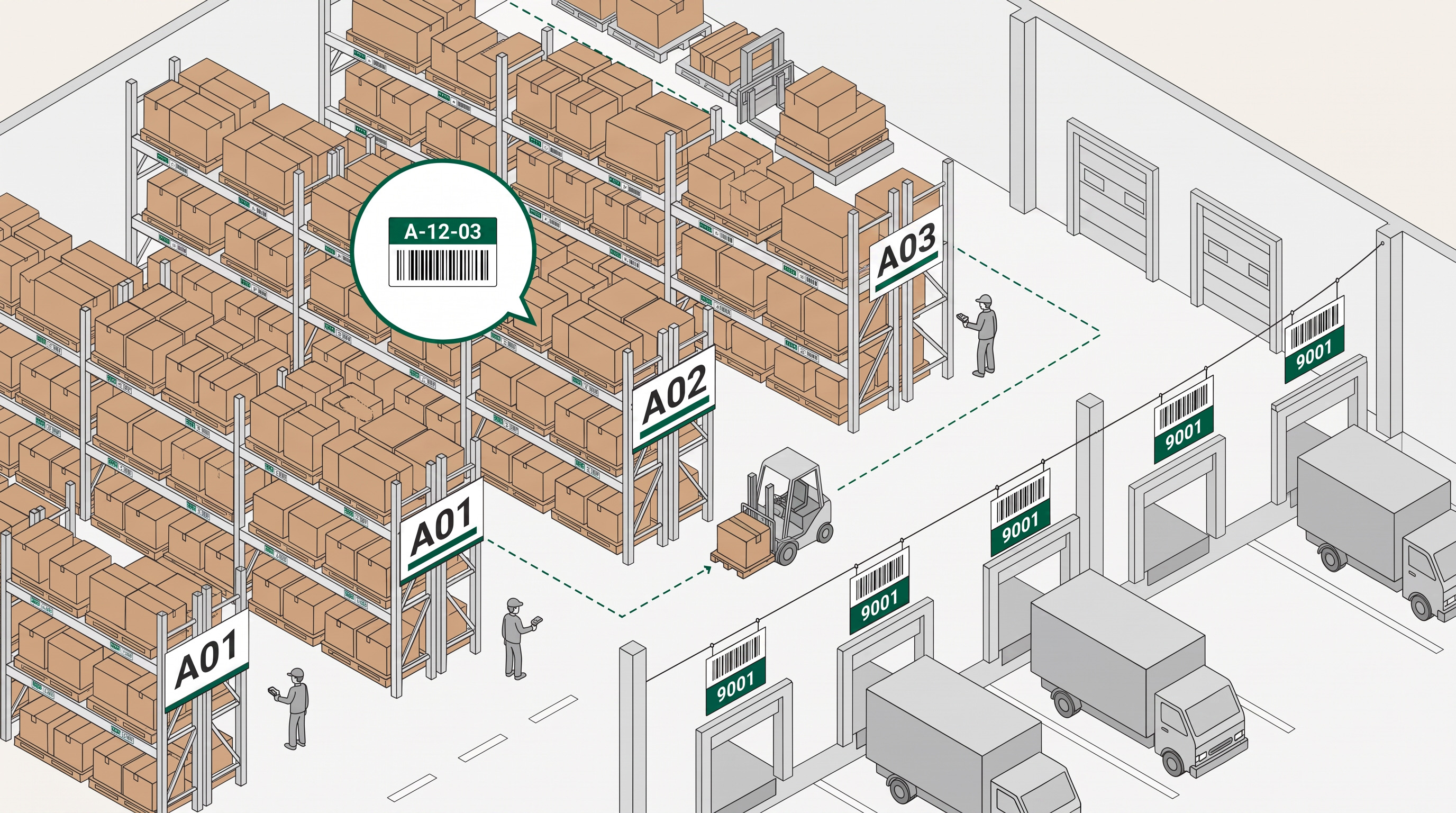
Warehouse rack labels are the barcode identifiers mounted on rack beams, shelves, bins, floors, and overhead signage that tell both people and scanners exactly where inventory lives. They are the physical layer your Warehouse Management System depends on. When labels fade, peel, or were poorly specified in the first place, pick accuracy drops, cycle counts slow down, and confidence in the WMS erodes — even though the software is working perfectly.
Warehouse operators spend heavily on inventory accuracy: implementing a WMS, upgrading mobile computers, investing in automation. Yet location labels and signage — the cheapest component in that stack — are usually the last thing anyone inspects and the first thing that quietly degrades performance.
A warehouse doesn’t stop operating because of a missing rack label. It simply becomes slower, less accurate, and more expensive.
We’ve covered print compliance and claims management in recent posts. This one addresses the other half of warehouse accuracy: making sure employees and barcode scanners can identify the correct storage location every single time.
What Is a Warehouse Rack Label?
A warehouse rack label is a durable, barcoded location identifier applied to pallet rack beams, shelving, or bins so that a scanner and an operator can confirm the exact storage position of inventory. Most encode a hierarchical location code — typically row, bay, level, and position — in both a machine-readable barcode and large human-readable characters.
Rack labels are one piece of a complete warehouse identification system, which also includes:
• Rack location labels
• Shelf labels
• Bin labels
• Floor labels
• Pallet location labels
• Hanging placards
• Aisle markers
• Dock door signs
• Long-distance retroreflective barcode signs
• Safety and facility signage
Together, these form the navigation system for your facility. Hardesty Technologies manufactures customized labels and signage for virtually every warehouse application — rack labels, aisle signs, hanging signs, dock door signs, pallet labels, freezer labels, magnetic labels, cover-up labels — along with complete installation services.
Without consistent location identification, every downstream warehouse process gets harder.
What Does Poor Warehouse Labeling Actually Cost You?
Poor labeling costs money in three measurable ways: slower picks, longer fork lift travel time, and degraded inventory accuracy. Most warehouses don’t replace labels until they’re completely unreadable — and by that point, they’ve already been draining productivity for months. A faded barcode or damaged location label increases the chance of pulling from the wrong location, and one incorrect pick cascades into customer complaints, returns, additional freight, inventory adjustments, and lost labor.
Slower Picking
When an employee hesitates because they aren’t certain they’re at the right location, every pick takes longer. Multiply a few seconds of hesitation across thousands of picks per day and the labor cost becomes significant.
Forklift Delays
High-bay warehouses depend on long-distance barcode scanning. A forklift operator shouldn’t have to leave the equipment or reposition the truck multiple times just to confirm a pallet location.
Retroreflective hanging placards and long-range barcode signs are engineered for scanning at distances beyond 30+ feet, letting operators identify locations quickly and safely from the seat.
Inventory Accuracy Issues
Cycle counts slow down. Put-away errors climb. Discrepancies grow. The result is a loss of confidence in the WMS, even though the software isn’t the problem. The labels are.
How Do You Choose the Right Warehouse Label Material?
The right warehouse label material is determined by the environment it lives in —temperature, abrasion, chemical exposure, and required scan distance — not by cost per label. Choosing the wrong material means paying to replace the same labels several times a year, which almost always costs more than specifying correctly the first time.
Consider whether your application involves:
• High-abrasion rack beams
• Freezer or cold storage environments
• Outdoor storage
• Chemical exposure
• Heavy forklift traffic
• Constant pallet movement
Beyond environment, specify labels against scan distance, surface type, cleaning requirements, expected lifespan, and the scanner technology already deployed inyour building. A properly designed labeling program lowers maintenance while moving scan rates year-round.
What Are Retroreflective Barcode Placards?
A retroreflective barcode placard is an overhead or rack-mounted sign built from reflective sheeting that returns scanner light directly back to its source, allowing a barcode to be read from long distances — including from the seat of a moving forklift.
Overhead signage is one of the most overlooked components of warehouse navigation. Large aisle markers and hanging placards let operators orient themselves across the building at a glance, which shortens travel time and reduces wrong-aisle trips.
For forklift drivers, retroreflective placards add a second advantage: they can scan storage locations from significant distances without stopping or dismounting. That reduces travel time while improving both productivity and safety.
Hardesty Technologies produces multiple placard styles — single-sided, double-sided, angled barcode signs, custom hanging signs, aisle markers, rack signs, and hanging zone markers — matched to your layout, ceiling height, and sight lines.
Why Installation Matters as Much as the Labels
Even a perfectly specified label creates problems if it’s installed inconsistently.Warehouse labeling is a data project as much as a physical one, and it requires planning across:
• Facility layout
• Rack numbering strategy
• Storage location hierarchy
• Barcode sequencing
• Print quality
• Installation consistency
• Go-live scheduling
We start with an assessment of your warehouse processes and layout, then build an efficient labeling plan before anything goes into production. From there we provide complete project management, on-site supervision, professional installation crews, materials, labor, equipment, and help preparing your warehouse location data for label production.
Whether you’re relabeling a single aisle or launching a new distribution center, planning ahead minimizes downtime and protects go-live accuracy.
How Often Should You Inspect Warehouse Labels?
Warehouse labels should be inspected at least annually, and reviewed any time you're-slot, expand, or implement a new WMS. Most operations already run scheduled inspections on forklifts, printers, mobile computers, and conveyor systems, but almost none inspect the labels those systems depend on.
An annual labeling assessment identifies:
• Damaged rack labels
• Missing placards
• Faded location signs
• Poor scan angles
• Worn floor labels
• Opportunities to improve navigation and reduce travel
Small corrections compound quickly when they’re applied across thousands of dailyscans.
Frequently Asked Questions
What is a warehouse rack label?
A warehouse rack label is a durable barcode ididentifier mounted on a pallet rack beam that marks a specific storage location. It carries a location code in both a scannable barcode and large human-readable characters, allowing operators and mobile computers to confirm the exact position of inventory during picking, put-away, and cycle counting.
What is the best material for warehouse rack labels?
Durable polyester with a high-tack permanent adhesive is the standard for most ambient warehouse rack beams. Freezer and cold storage locations require a cold-temperature adhesive, outdoor and high-abrasion areas need heavier protective constructions, and frequently re-slotted locations are better served by magnetic labels that leave no residue.
How far away can a warehouse barcode label be scanned?
Standard rack labels are read at close range with a handheld or wearable scanner. Retroreflective barcode signs are built for long-range scanning at distances beyond 30+feet, which lets forklift operators identify high-bay pallet positions without leaving the truck. Even though most times scanning range depends on the scanner you're using.
What is a retroreflective barcode placard?
A retroreflective barcode placard is a rack or overhead sign made from reflective sheeting that returns scanner light back toward its source. That construction makes the barcode readable from long distances and from off-angle positions, which is why it’s used for high-bay locations and aisle identification. Fun fact: retroreflective material actually doubles the scanning range of your scanner. (i.e if you're scanner or mobile computer is rated to scan up to 30 ft if you were to scan a retroreflective label you could then scan from 60 ft.)
How long do warehouse rack labels last?
Lifespan depends almost entirely on material selection and environment. Labels that fail early are usually a specification problem — the wrong adhesive, face stock, or placement for the abrasion and traffic in that location — rather than a manufacturing defect. Most labels will last 10+ years in a ideal environment.
Can you use barcode labels in a freezer or cold storage warehouse?
Yes. Freezer labels use specialized cold-temperature adhesives designed to bond and stay bonded at low temperatures, including application to already-cold surfaces.Standard permanent adhesives lose tack in these environments and lift at the edges, which is the most common cause of failed labels in refrigerated facilities.
Should you install warehouse labels yourself or hire a professional installer?
In-house installation can work for a small relabel in an accessible area. Full-facility projects, high-bay installations, and WMS go-lives benefit from professional crews because consistency of placement — height, angle, and sequence — directly affects scan rates. Professional installation also removes lift equipment and downtime scheduling from your team.
What is serpentine rack numbering?
Serpentine numbering assigns location codes in a continuous back-and-forth path through the facility, so the sequence runs down one side of an aisle and back up the next rather than restarting each row. It reduces operator travel on multi-stop picks.
Build a Warehouse That’s Easier to Navigate and Faster to Scan
Warehouse labels aren’t just identifiers. They’re operational infrastructure and the combination of correct materials, thoughtful placement, optimized scan distances, protective overlays, and expert installation is what turns your WMS investment into measurable accuracy and throughput.
Hardesty Technologies designs, manufactures, installs, and maintains complete warehouse labeling solutions: rack labels, retroreflective barcode placards, aisle signage, dock door signs, and full-service installation. Because when every scan matters, every label matters too.
Email our team today to get started: Sales@hardestytech.com
About the Author
Joe Leucht is Director of Commercial Strategy at Hardesty Technologies and an 18-year veteran of warehouse and supply chain technology. His experience spans barcode, RFID, mobile computing, wireless connectivity, warehouse technology, managed services and lifecycle strategy. At Hardesty Technologies, Joe works with organizations to connect technology investments to real-world operational challenges — helping distribution and logistics teams improve visibility, productivity, accuracy and the reliability of the systems their operations depend on.
His perspective is grounded in the belief that technology should solve operational problems, not simply add another layer of complexity.